 Peter Maes, Director of Transformation Koppert, Berkel en Rodenrijs
When in 2017 we were invited to create the book ‘Partners with Nature’ to mark Koppert’s fiftieth anniversary, we knew nothing about the company in Berkel en Rodenrijs, on the outskirts of Rotterdam. It was founded by Jan Koppert, who in 1967, in a small cucumber greenhouse, in search of an alternative to the use of chemicals against red spider mite in his cucumbers, started to experiment with the rearing of predatory mites that killed those very pests. That’s how Jan Koppert became one of the founders of biological crop protection and the biological approach to controlling pests.
In fifty years, Jan Koppert’s company had grown to become the global market leader in biological solutions for agriculture and horticulture that use natural enemies to combat infestations, bumble bees for natural pollination, and microbials and biostimulants to support, protect and strengthen crops both above and below the ground.
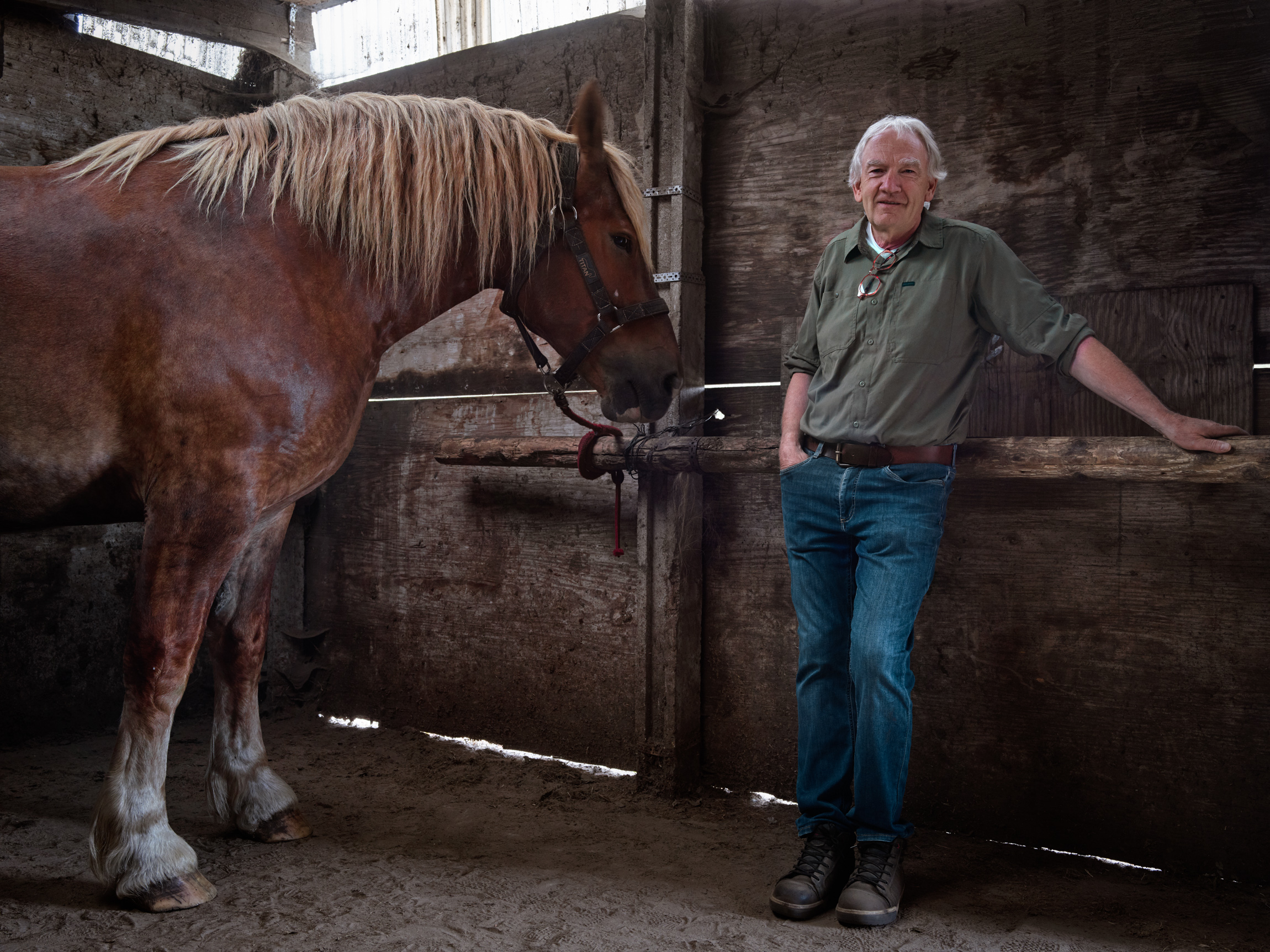
So there we were, on a beautiful spring day in May 2016 in the entrance hall of Koppert’s head office in Berkel en Rodenrijs, waiting for our meeting with Peter Maes. Peter welcomed us in his office on the first floor with a view of the laboratories, a typical director’s office with a desk stacked with files and behind the desk an office cabinet displaying trophies, awards and corporate gifts from all over the world. On the wall was a photograph of his two horses, French draught horses, and on the opposite wall a large video screen for his endless Zoom meetings with the world.
We took our seats at the conference table, where my eye fell on a plastic office accessory: an office organizer intended for paperclips, staples, pencils and pens. Sticking out of it, in place of the pencils and pens, were four paring knives. Why these strange office accessories were there would become clear to me a few moments later. I asked Peter about the photograph of the horses, and they turned out to be a hobby and a form of release for a man who has devoted his life to making farming sustainable.
French draught horses are the strongest cart horses in the world and can be recognized by the long ‘feathers’ on their legs. In the days before motorized transport, the horses were used for traction on farms, although the fish markets in Paris were also dependent on the power of these horses and their eagerness to work, using them to bring fresh fish from Boulogne sur Mer on the north-west coast of France to Paris along the Route du Poisson.
Peter’s horses are kept in Geel, Belgium, Peter’s birthplace, where he still lives. It is the place where he grew up and his grandparents ran the farm. The place where he developed his love for nature and farming.
Suddenly, Peter stood up from his desk, took an apple out of the desk drawer and picked up one of the paring knives. He started peeling the apple.
‘Imagine this apple is our planet, with the seeds in the core, and around that the flesh and the thin peel that we know contains the most minerals and vitamins. This thin peel is the fertile soil on which and from which we have to live. Treating it with care, knowing that it’s only a very thin layer – that’s why I’ve now been devoting myself to making farming sustainable for more than 35 years.’
Even as a young lad, he intuitively had concerns about the use of pesticides. When he stayed at his grandparents’ farm in the summer months and watched his grandmother attack everything that hummed and buzzed with a big flit sprayer, he began to have reservations. On Sundays he would walk across the land with his grandpa to look at the grain that was ripe for bringing in, at the potatoes that could now be harvested, before at the end of the day joining everyone at the kitchen table to drink a glass of small beer. But before they sat down, the table had to be swept, since it was covered in dead stable flies and the white powder that had killed them. It was that contradiction: one moment looking at the crops that nature had produced and the next seeing what his grandfather needed to do to make them workable, harvestable and profitable by using artificial fertilizers and pesticides.
It was the reason why Peter decided to study agriculture. But even then he did not find the answers he was looking for. The prevailing dogma at agricultural college was ‘without artificial fertilizers and chemicals, no viable yields’. He learned a long list of chemical substances and their effects. There surely must be other ways of producing our food. So after graduating, Peter did a Master’s in human ecology that investigated the interrelationship between human actions and economics and their effects. In retrospect, it was actually all about sustainability, avant la lettre: hardly anyone used the word ‘sustainability’ in 1989. It set Peter on the right path, and he went on to contribute to making agriculture and horticulture sustainable.
We visited Peter in his birth village, Geel, in Belgium, where Peter keeps his French draught horses at the place where his grandparents had their farm. There Peter tells his story on film.
‘There are simply other ways to produce our food, ways that don’t rely entirely on artificial fertilizers and chemical pesticides. What we must do is get microbiological life, biodiversity and therefore organic material into the soil. That way it can be used for coming generations too in a way that is resilient. That’s what I’ve been trying to do for 35 years in the world of biological crop protection, and I’ve now been doing it for 27 years at Koppert. First of all to make a contribution to sustainability, and secondly to take the sector and society along with me in the stories that make visible the fact that there really are other ways to produce the food we need every day sustainably. If we truly work together, we can ensure that fertile soil is available to the next generation as well. That’s what I devote myself to every day with great energy and pleasure, and so I’m also making my contribution to Resilience Food Stories.’
‘There are simply other ways to produce our food, ways that don’t rely entirely on artificial fertilizers and chemical pesticides. What we must do is get microbiological life, biodiversity and therefore organic material into the soil. That way it can be used for coming generations too in a way that is resilient.
Peter Maes