 Article in Kunstschrift by Frits Gierstberg, Art historian, curator, researcher, and writer
'As a result, this work aligns so beautifully for me with the demands and expectations of our time: human, unhurried, engaged, and open to dialogue.'
Frits GierstbergArt historian, curator, researcher, and writer
The images of a farm are among the earliest photographs in history. William Henry Fox Talbot, the inventor of the negative, published them in 1844 in the album ‘The Pencil of Nature’. The salt prints contained therein show, among other things, a haystack on the grounds of Lacock Abbey, Wiltshire.
‘The Haystack’, as Talbot called this image, is one of the most famous photographs in early photography history. There are no people in it; the exposure time was too long for that. What Talbot was concerned with, and what the title of his publication refers to, was to show that nature could draw itself in detail. And nature could be found at the farmer’s, who, as a human being, stood closer to the origin of all life than the urban photographer with his camera. ‘The Haystack’ gave the viewer the opportunity to reflect on this properly.
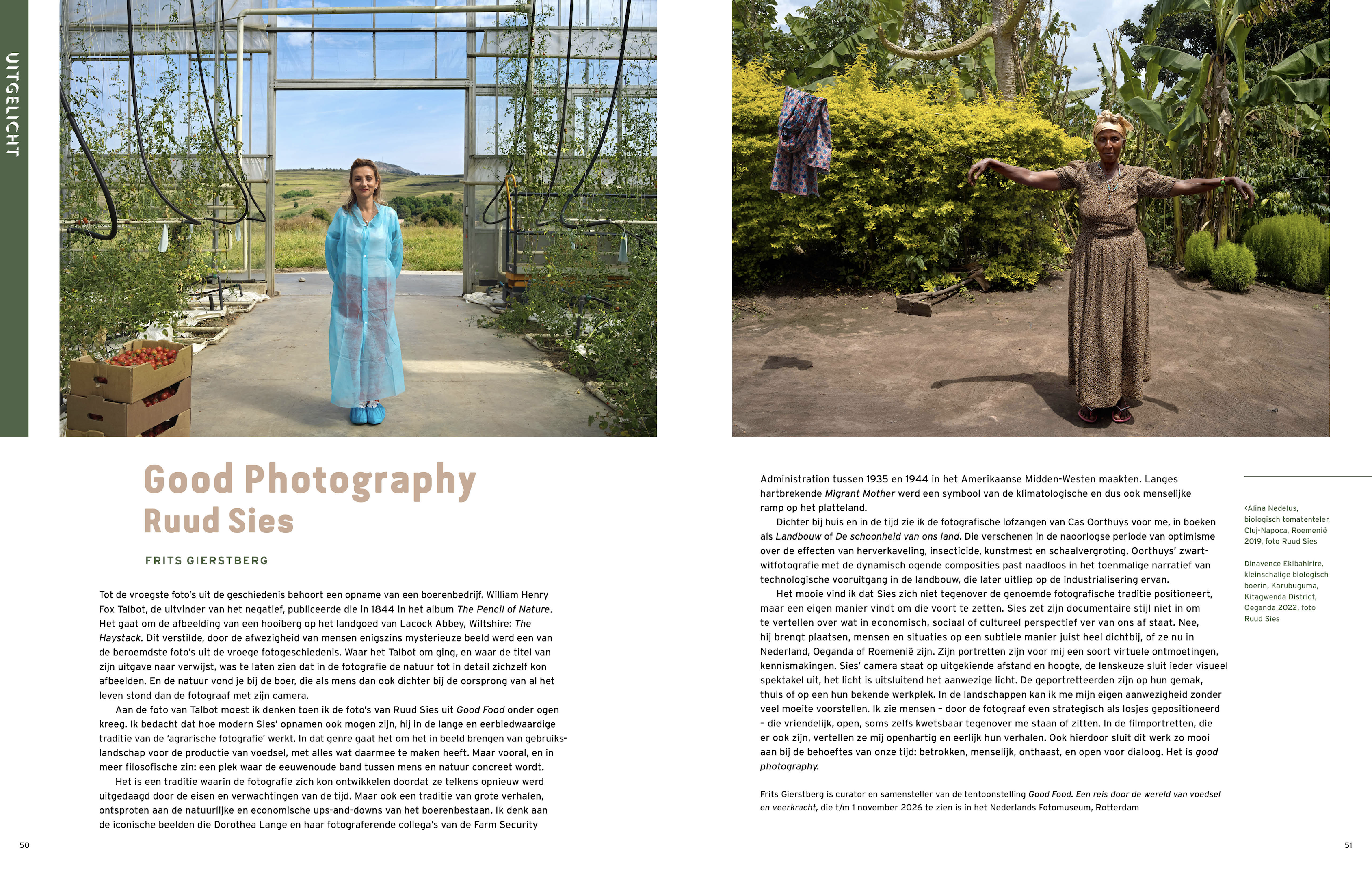
I was reminded of Talbot’s photograph when I saw the photos by Ruud Sies from ‘Resilience Food Stories’ (Good Food). I realized that however ‘modern’ Sies’ photographs may be, he works within the long and venerable tradition of ‘agricultural photography.’ That genre is about capturing the landscape used for food production, with everything associated with it. People, for example, and animals, tools, machinery, storage facilities, barns, stables, and semi-finished products such as hay and manure. But above all, and in a more philosophical sense: a place where the age-old bond between man and nature becomes visible.
It is a tradition in which photography was able to develop because it was repeatedly challenged by the demands and expectations of the times. But it is also a tradition of grand narratives that move along with the natural and economic ups and downs of farming life. I am thinking of the iconic images that Dorothea Lange and her fellow photographers from the Farm Security Administration created in the American Midwest between 1935 and 1944. Lange’s heartbreaking ‘Migrant Mother’ became a symbol of the climatic and, consequently, human disaster in the countryside. Closer to home and in time, I picture the photographic hymns of praise by Cas Oorthuys in books such as ‘Agriculture’ or ‘The Beauty of Our Country’. These appeared during the post-war period of optimism regarding the effects of land consolidation, insecticides, artificial fertilizers, and scaling up. His black-and-white photography with its dynamic perspectives fits seamlessly into the narrative of the time regarding technological progress in agriculture, which ultimately led to its industrialization.
What I find beautiful is that Sies does not position himself against the aforementioned photographic tradition but finds his own way to continue it. However, Sies does not employ his documentary style to tell us about what is far removed from us in an economic, social, or cultural perspective (which is also a tradition in photography), but rather brings places, people, and situations closer in a subtle way. Whether that be in Uganda or Romania. For me, his portraits and accompanying landscapes are introductions through the image. The camera’s gaze is a balanced, calm, ‘natural’ gaze, which facilitates perception in such a way that it is as if I, the viewer, am standing there myself. The camera is positioned at a carefully calculated distance and height, the choice of lens excludes any visual spectacle, and the light is exclusively natural, present light. The subjects are at ease, at home or in a familiar workplace, which gives their narratives a natural and therefore authentic character. In the landscapes, I can imagine my own presence without much difficulty. I see people—positioned by the photographer as strategically as they are casually—standing or sitting opposite me in a friendly, open, and sometimes even vulnerable manner, telling their stories to me candidly and honestly (not everything they do succeeds, as it turns out).
As a result, this work aligns so beautifully for me with the demands and expectations of our time: human, unhurried, engaged, and open to dialogue.
Frits Gierstberg
Art historian, curator, researcher, and writer
Frits Gierstberg is the curator of the exhibition Good Food: A Journey Through the World of Food and Resilience, which is on view at the Nederlands Fotomuseum, Rotterdam, until 1 November 2026.